EN
Powder coating is a dry finishing process in which electrostatically charged powder particles are applied to a surface and then cured under heat — typically between 160°C and 210°C (320°F–410°F) — to form a hard, smooth, or textured film. Unlike liquid paint, it contains no solvents and releases negligible volatile organic compounds (VOCs), making it both a high-performance and environmentally responsible choice.
The core conclusion upfront: powder coating delivers superior durability, consistent coverage, and long-term cost efficiency compared to most conventional liquid coatings. It is widely used in architecture, automotive parts, appliances, outdoor furniture, and industrial equipment.
Understanding the process helps set realistic expectations for quality and lead time. The standard workflow involves three stages:
Some specialty powders — UV-cure and low-temperature formulas — cure below 130°C, enabling use on heat-sensitive materials such as MDF, plastics, and certain composites.
Powder coatings are classified by their resin chemistry, each suited to different performance requirements:
| Type | Key Strength | Typical Use |
| Epoxy | Excellent adhesion & chemical resistance | Indoor metal parts, pipelines |
| Polyester (TGIC) | UV stability, outdoor durability | Architectural facades, outdoor furniture |
| Polyurethane | Smooth finish, scratch resistance | Automotive trim, consumer goods |
| Epoxy-Polyester Hybrid | Balanced cost and performance | Appliances, shelving, general industry |
| Fluoropolymer (PVDF) | Exceptional weather & color retention | High-end architectural cladding |
For most outdoor structural applications, TGIC polyester is the industry default due to its balance of UV resistance and cost. PVDF coatings are specified when 20–30 year color retention guarantees are required.
Coating thickness directly affects performance. The standard range for architectural and general industrial applications is 60–80 microns (µm). Deviating from this range carries real consequences:
Thickness is measured non-destructively using an eddy-current or magnetic induction gauge after curing.
One of the most underestimated advantages of powder coating is its versatility in appearance. Available finish types include:
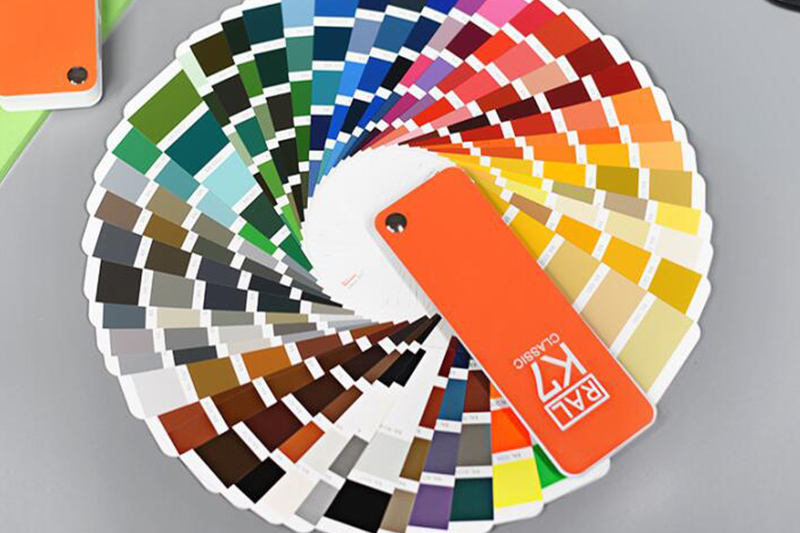
Color matching is possible using RAL, Pantone, or custom spectrophotometric targets, though batch-to-batch color consistency requires tight oven calibration — a detail often overlooked in quality control.
When choosing a finishing method, the differences go beyond appearance:
| Factor | Powder Coating | Liquid Paint |
| VOC Emissions | Near zero | High (solvent-based types) |
| Material Efficiency | Up to 98% (overspray reclaim) | 30–70% |
| Cure Time | 10–20 min (oven) | Hours to days (air dry) |
| Impact Resistance | High | Moderate |
| Thin/Complex Edges | Faraday cage effect can reduce coverage | Better penetration |
| Substrate Limitation | Requires heat-tolerant materials | Applied to almost any surface |
Powder coating is not always the better choice — for large structures that cannot be placed in an oven, or for heat-sensitive assemblies, liquid systems remain the only practical option.
Powder coated steel panels typically achieve 500–1,000 hours in a neutral salt spray test (ISO 9227) without corrosion creep at a scribe line, depending on the pre-treatment and powder chemistry. Aluminum components with a chromate conversion coating beneath the powder frequently exceed 2,000 hours.
For outdoor UV exposure, TGIC polyester powders rated to Class 3 (QUALICOAT certification) retain over 50% gloss and ΔE color change below 5 units after 10 years of Florida south-facing exposure testing — a benchmark widely cited in the architectural industry.
Any substrate that can be electrically grounded and withstand curing temperatures is a candidate. Common materials include:
A well-applied powder coating finish requires minimal maintenance, but the right practices extend its life significantly:
Knowing what defects look like helps in quality inspection and supplier evaluation:
| Defect | Appearance | Likely Cause |
| Orange peel | Textured, bumpy surface | Wrong cure temp or powder viscosity |
| Pinholes / craters | Small surface voids | Outgassing from substrate or contamination |
| Fish eyes | Circular depressions with raised edges | Oil or silicone contamination on substrate |
| Color variation | Uneven tone across part | Oven hot spots or inconsistent thickness |
| Adhesion failure | Peeling or flaking | Poor surface prep or incompatible pre-treatment |
With proper surface preparation and maintenance, 15–20 years outdoors is achievable using quality polyester powder. Indoor applications can last even longer.
Not recommended. Existing coatings should be fully stripped — by chemical stripping, sandblasting, or thermal burn-off — before recoating to ensure proper adhesion and film integrity.
Fully cured powder coatings are generally inert and non-toxic. However, only formulations that have been specifically certified for food contact (per FDA or EU regulations) should be used on food preparation surfaces.
Small chips can be touched up with compatible liquid paint as a stopgap, but seamless repair requires the full part to be stripped and recoated. Touch-ups are always visible under close inspection.
This depends on the supplier, but most powder manufacturers set a minimum batch of 25–50 kg for custom color production. Standard RAL and stock colors have no such minimum.
At a typical 60–80 µm film, the weight addition is negligible — roughly 100–150 g/m². Dimensional impact is also minimal for most engineering tolerances.


Copyright © Zhejiang Huacai Advanced Material CO., LTD. All Rights Reserved. Powder Coating Manufacturers

 中文简体
中文简体 English